Introduction
English is one of the most widely spoken languages in the world. A strong vocabulary helps people communicate clearly, understand written information and express their thoughts confidently.
Learning English words alphabetically is a simple and organized way to improve vocabulary. After exploring words beginning with A, B, C and D, the next step is to learn words starting with the letter “E.”
The letter E begins many useful English words, such as ear, eat, easy, earth, early, enjoy, energy, education and experience.
This article provides a collection of English words starting with E, along with their meanings, example sentences, word lengths and practical vocabulary-learning strategies.
1. The Importance of the Letter E
“E” is the fifth letter of the English alphabet. It is also the most frequently used letter in many forms of written English.
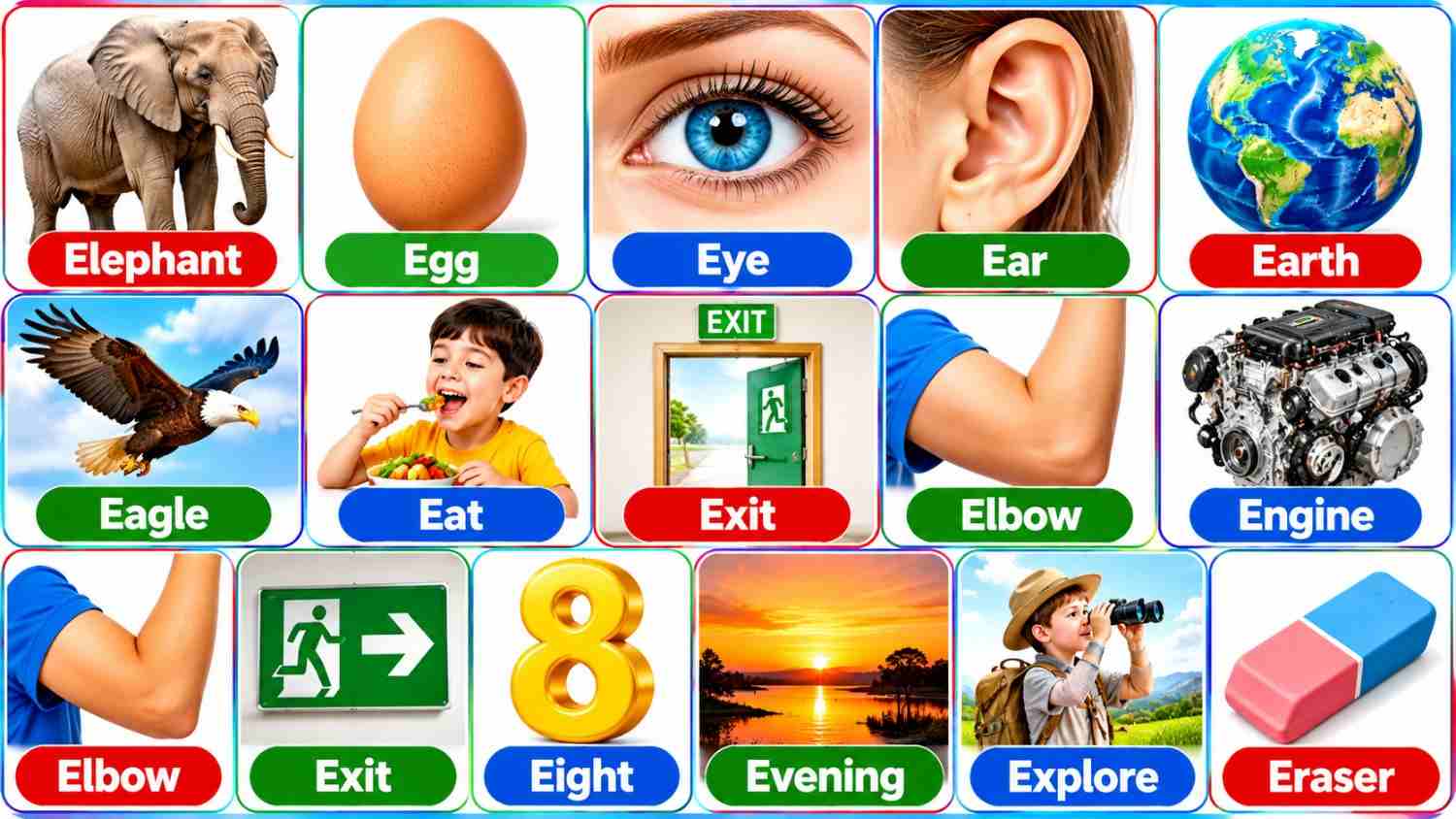
Many everyday words begin with E, including egg, eye, ear, eat, end, easy, early and evening.
The letter E also appears in advanced vocabulary used in education, science, business and professional communication. Examples include environment, examination, experience, explanation and engineering.
Learning E words can help students, professionals and English learners improve their reading, writing, listening and speaking skills.
2. Two-Letter English Words Starting with E
There are very few two-letter English words beginning with E. One commonly recognized example is:
| Word | Meaning | Example |
|---|---|---|
| Eh | An informal expression used to ask someone to repeat something or to show surprise | Eh? Could you repeat that? |
Note: “Eh” is an informal interjection. There are not many commonly used two-letter words beginning with E in everyday English.
3. Three-Letter English Words Starting with E
| Word | Meaning | Example |
|---|---|---|
| Ear | The body part used for hearing | My ear hurts. |
| Eat | To take food into the mouth | We eat lunch at noon. |
| Egg | An oval food produced by birds | I ate an egg for breakfast. |
| End | The final part of something | This is the end of the story. |
| Eye | The body part used for seeing | She has blue eyes. |
| Elf | A small magical character in stories | The story features an elf. |
| Era | A particular period in history | We live in the digital era. |
| Eve | The day or evening before an event | We met on Christmas Eve. |
| Eel | A long, snake-like fish | An eel lives in the water. |
| Ebb | The movement of the tide away from the shore | The tide began to ebb. |
4. Four-Letter English Words Starting with E
| Word | Meaning | Example |
|---|---|---|
| Each | Every one of two or more things | Each student received a book. |
| Earn | To receive money for work | She wants to earn money. |
| East | A direction where the sun rises | The sun rises in the east. |
| Easy | Not difficult | This question is easy. |
| Echo | A sound repeated after reflection | We heard an echo in the cave. |
| Edge | The outer boundary of something | Do not stand near the edge. |
| Else | In addition or otherwise | Would you like anything else? |
| Even | Flat or equal; also used for emphasis | The floor is even. |
| Ever | At any time | Have you ever visited London? |
| Exit | A way out of a place | Please use the emergency exit. |
5. Five-Letter English Words Starting with E
| Word | Meaning | Example |
|---|---|---|
| Early | Before the expected time | I wake up early. |
| Earth | The planet on which we live | Earth moves around the Sun. |
| Empty | Containing nothing | The bottle is empty. |
| Enjoy | To take pleasure in something | I enjoy reading books. |
| Enter | To go inside a place | Please enter the room. |
| Event | Something that happens, especially a planned occasion | We attended a school event. |
| Every | Each individual person or thing | Every student must participate. |
| Exact | Completely correct or accurate | Please give me the exact time. |
| Extra | More than what is usual or necessary | I need extra time. |
| A message sent electronically | I received your email. |
6. Six-Letter English Words Starting with E
| Word | Meaning | Example |
|---|---|---|
| Easily | Without difficulty | She learns new words easily. |
| Effect | A result or change caused by something | The medicine had a positive effect. |
| Effort | Physical or mental energy used to do something | Success requires effort. |
| Either | One or the other of two choices | You can choose either option. |
| Eleven | The number after ten | There are eleven players on the team. |
| Energy | The ability to do work or be active | Children have a lot of energy. |
| Engine | A machine that produces power | The car engine is powerful. |
| Escape | To get away from a place or situation | The bird managed to escape. |
| Estate | A large area of land or property | The family owns a large estate. |
| Expert | A person with special knowledge or skill | She is an expert in science. |
7. Seven-Letter English Words Starting with E
| Word | Meaning | Example |
|---|---|---|
| Earning | Money received from work | His monthly earning is increasing. |
| Ecology | The study of relationships between living things and their environment | Ecology is an important subject. |
| Edition | A particular version of a book or publication | I bought the latest edition. |
| Educate | To teach or provide knowledge | Schools educate children. |
| Elastic | Able to stretch and return to its shape | This material is elastic. |
| Elegant | Graceful and attractive | She wore an elegant dress. |
| Element | A basic part of something | Water is an important element of life. |
| Emotion | A strong feeling | Happiness is a positive emotion. |
| Emperor | A male ruler of an empire | The emperor ruled the country. |
| Evening | The later part of the day | We went for a walk in the evening. |
8. Eight-Letter English Words Starting with E
| Word | Meaning | Example |
|---|---|---|
| Education | The process of learning and gaining knowledge | Education is important for everyone. |
| Effective | Producing the intended result | This is an effective method. |
| Election | The process of choosing leaders by voting | The election will take place next month. |
| Employee | A person who works for an organization | Every employee received a certificate. |
| Employer | A person or organization that provides work | The employer offered a new contract. |
| Exercise | Physical activity or a learning task | Regular exercise supports good health. |
| Excellent | Extremely good | You did an excellent job. |
| Exciting | Causing great interest or enthusiasm | It was an exciting match. |
| Existence | The state of being real or alive | Scientists study the existence of life. |
| Evidence | Facts or information that support a claim | The police collected evidence. |
9. Nine-Letter English Words Starting with E
| Word | Meaning | Example |
|---|---|---|
| Education | The process of gaining knowledge | Education can create opportunities. |
| Effective | Producing a successful result | We need an effective solution. |
| Emotional | Related to feelings | It was an emotional moment. |
| Emergency | A serious situation requiring immediate action | Call for help during an emergency. |
| Employee | A person who works for an employer | The employee arrived on time. |
| Engineer | A person who designs or builds machines, structures or systems | My brother wants to become an engineer. |
| Excellent | Extremely good | The team delivered an excellent performance. |
| Exercise | Physical activity or practice | Exercise is useful for learning and fitness. |
| Expensive | Costing a lot of money | This phone is expensive. |
| Extension | An additional part or period | We requested an extension. |
10. Ten-Letter English Words Starting with E
| Word | Meaning | Example |
|---|---|---|
| Earthquake | A sudden shaking of the ground | The earthquake damaged several buildings. |
| Education | The process of teaching and learning | Education helps people develop knowledge. |
| Electronic | Related to devices that use electricity and electronic circuits | I bought an electronic device. |
| Employment | The condition of having paid work | Employment opportunities are important. |
| Encouraged | Given support or confidence | The teacher encouraged the students. |
| Engagement | Involvement or participation in something | Student engagement is important in class. |
| Enterprise | A business or an organized project | She started a small enterprise. |
| Experience | Knowledge gained through doing something | Work experience can be valuable. |
| Exhibition | A public display of objects or works | We visited an art exhibition. |
| Expression | The act of communicating thoughts or feelings | Facial expression can show emotions. |
11. Classification of E Words by Learning Level
Basic Level
Beginners should first learn simple E words that are frequently used in everyday conversations.
- Ear – The body part used for hearing.
- Eat – To take food.
- Egg – Food produced by birds.
- Eye – The body part used for seeing.
- Easy – Not difficult.
- East – A direction.
- Early – Before the expected time.
- Earth – The planet we live on.
- Empty – Containing nothing.
- Enjoy – To take pleasure in something.
Example:
I enjoy eating eggs for breakfast.
Intermediate Level
Intermediate learners should focus on words used in education, workplaces and everyday communication.
- Effort – Energy used to do something.
- Energy – The ability to do work.
- Escape – To get away.
- Event – Something that happens.
- Element – A basic part of something.
- Emotion – A strong feeling.
- Employee – A person who works for an organization.
- Employer – A person or organization that provides work.
- Evidence – Information supporting a claim.
- Excellent – Extremely good.
Example:
Every employee should make an effort to complete their work effectively.
Advanced Level
Advanced learners should study words commonly used in academic writing, science, business and professional communication.
- Environment – The natural world or surrounding conditions.
- Entrepreneur – A person who starts and manages a business.
- Examination – A formal test of knowledge or ability.
- Establishment – The act of creating or setting up something.
- Elaboration – The addition of more details or explanation.
- Evaluation – The process of judging quality or performance.
- Expansion – The process of becoming larger.
- Exceptional – Unusually good or remarkable.
- Experimental – Related to testing or scientific experiments.
- Enthusiasm – Strong interest or excitement.
Example:
Successful business expansion requires careful evaluation and effective management.
12. Classification of E Words by Parts of Speech
Words beginning with E can perform different grammatical functions.
| Part of Speech | Examples | Sample Sentence |
|---|---|---|
| Noun | Egg, earth, energy, education | Education creates opportunities. |
| Verb | Eat, earn, enjoy, enter | I enjoy learning English. |
| Adjective | Easy, empty, excellent, emotional | This is an excellent book. |
| Adverb | Easily, early, eventually | She completed the task easily. |
| Preposition | Except, excluding | Everyone came except John. |
Understanding parts of speech helps learners use English vocabulary correctly in sentences.
13. Positive E Words
Many E words express positive qualities, achievements and useful ideas.
- Excellent
- Education
- Encouragement
- Enthusiasm
- Empowerment
- Effort
- Effective
- Elegant
- Enjoyment
- Excellence
These words are useful in motivational writing, speeches, essays and professional communication.
Example:
Education, effort and enthusiasm can help people achieve excellence.
14. Challenging or Negative E Words
Some E words describe difficult situations, problems or negative experiences.
- Error
- Enemy
- Emergency
- Exhaustion
- Embarrassment
- Envy
- Expense
- Evil
- Exclusion
- Exploitation
These words are useful when discussing problems, social issues and challenging situations.
Example:
Careful planning can help reduce errors and unnecessary expenses.
15. Commonly Confused E Words
Some English words beginning with E are confusing because they have similar spellings or meanings.
Effect vs Affect
Effect is usually a noun meaning a result or consequence.
Example: The new rule had a positive effect.
Affect is usually a verb meaning to influence something.
Example: Weather can affect our travel plans.
Especially vs Specially
Especially means particularly or more than others.
Example: I enjoy reading, especially history books.
Specially means for a particular purpose.
Example: This room was specially designed for children.
Economic vs Economical
Economic relates to the economy or financial system.
Example: The country is facing economic challenges.
Economical means saving money or resources.
Example: This car is economical to run.
Learning these differences can help learners avoid common English mistakes.
16. Best Ways to Improve Vocabulary
Improving vocabulary requires regular practice and consistent effort. The following strategies can help learners develop their English vocabulary effectively.
1. Read Regularly
Read English books, newspapers, articles and educational materials. Whenever you find a new E word, write down its meaning and an example sentence.
2. Learn Words by Topic
Learning related words together can make vocabulary easier to remember.
Education: Exam, education, essay, exercise.
Work: Employee, employer, employment, effort.
Nature: Earth, environment, ecology, energy.
Daily Life: Eat, egg, early, evening.
3. Make Vocabulary Notes
Write each new word with its:
- Meaning
- Pronunciation
- Part of speech
- Example sentence
- Synonym
- Antonym
For example:
Encouragement – Support that gives someone confidence.
Example: Her teacher gave her encouragement.
4. Practice New Words
Create your own sentences and use newly learned E words in everyday communication.
Examples:
I eat breakfast early.
Education is important for everyone.
We should protect the environment.
She has excellent communication skills.
5. Use Multimedia Resources
Watch English educational videos, listen to podcasts and use pronunciation resources to improve listening and speaking skills.
6. Review Regularly
Review newly learned words several times. Regular revision helps learners remember vocabulary for a longer period.
17. A Simple E-Word Practice Exercise
Complete the following sentences using the correct E word.
- We use our ______ to hear sounds.
- I ______ breakfast every morning.
- The opposite of full is ______.
- She wants to ______ money.
- The sun rises in the ______.
- Regular ______ supports good health.
- Every ______ should follow workplace rules.
- We should protect the ______.
- This is an ______ idea.
- Learning requires time and ______.
Answers:
- Ear
- Eat
- Empty
- Earn
- East
- Exercise
- Employee
- Environment
- Excellent
- Effort
18. Conclusion
English words beginning with the letter E are important for everyday communication, education, business, science and professional life. From simple words such as ear, eat, egg and easy to advanced vocabulary such as environment, evaluation, employment and entrepreneur, E words offer learners many useful ways to express their thoughts and ideas.
Learning vocabulary alphabetically makes the process more organized and easier to manage. However, memorizing words alone is not enough. Learners should also understand their meanings, pronunciation, grammatical functions and usage in real sentences.
By reading regularly, making vocabulary notes, practicing new words and reviewing them frequently, learners can gradually build a stronger English vocabulary.
Every new word learned is another step toward better English communication, greater confidence and lifelong learning.
Learn a new word every day and make your English stronger every day.
👉 Learn more
Disclaimer: This article is created for educational and informational purposes only. The English words, meanings, and example sentences are provided to help readers improve their vocabulary and communication skills. Some words may have different meanings depending on their context and usage. We aim to provide accurate information, but readers are encouraged to consult reliable dictionaries for further clarification.