Introduction
English is one of the richest and most widely spoken languages in the world. It contains a vast number of words that help people express their thoughts, feelings, ideas and experiences clearly. Building a strong vocabulary is one of the most important parts of learning English.
Learning English words alphabetically makes the vocabulary-building process more organized, systematic and effective. After exploring words beginning with A, B and C, the next important step is to learn English words starting with the letter “D.”
The letter D begins many common English words used in everyday conversations, education, business, science, technology and professional communication.
This article provides a useful collection of English words starting with D, including their meanings, examples, word lengths and effective vocabulary-learning strategies.
1. The Importance of the Letter D
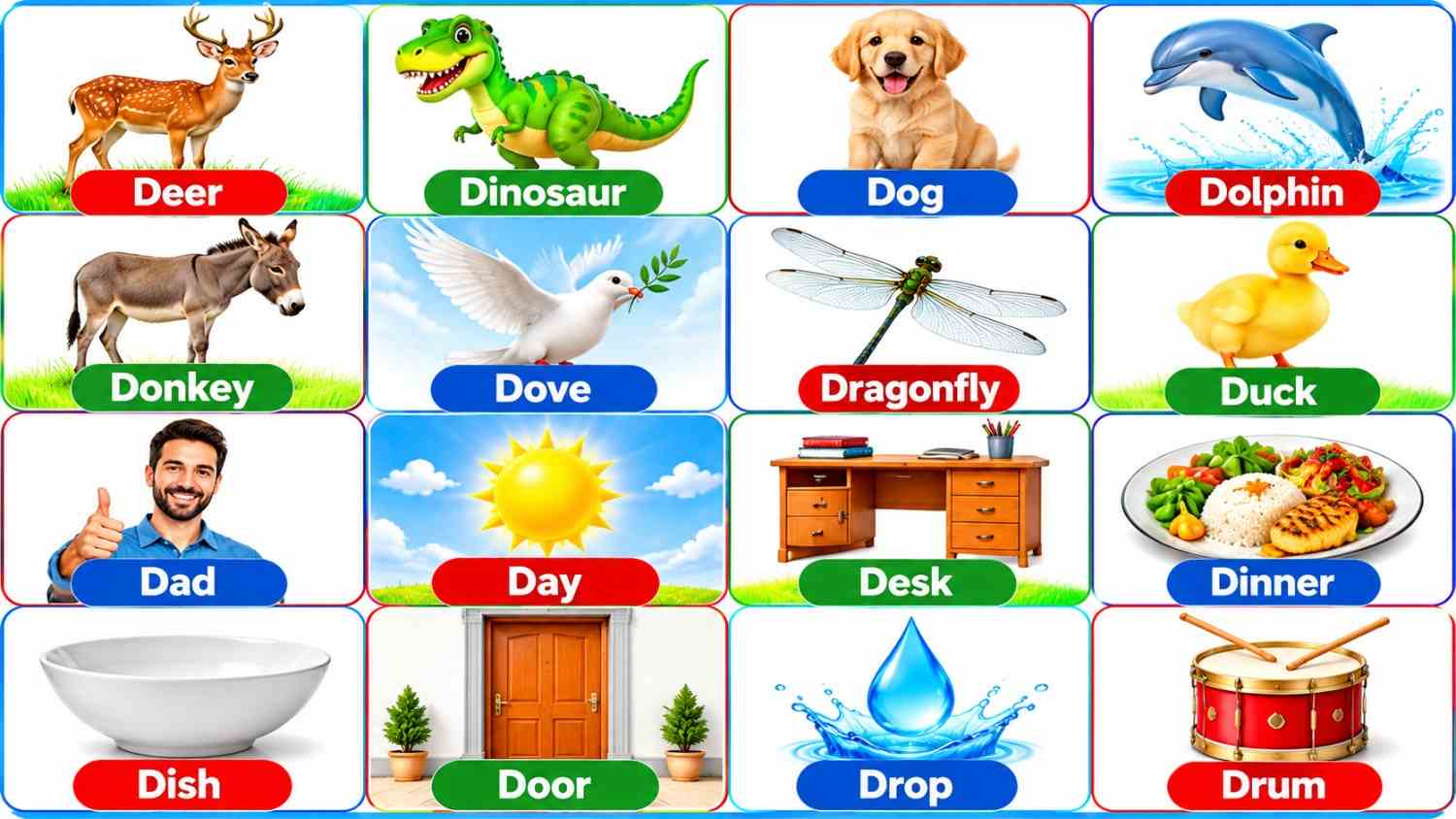
“D” is the fourth letter of the English alphabet. Many commonly used words, such as day, dog, door, dark, dance, dream, drink and drive, begin with D.
There are also several advanced English words beginning with D, including development, determination, discipline, communication and demonstration.
These words are frequently used in everyday conversations, academic writing, business communication and professional life.
Learning D words can help learners improve their vocabulary, develop confidence and communicate more effectively in English.
2. Two-Letter English Words Starting with D
There are very few commonly used English words beginning with D that contain only two letters.
| Word | Meaning | Example |
|---|---|---|
| Do | To perform an action | I do my homework every day. |
| Dr | Abbreviation for Doctor | Dr Smith is a good doctor. |
Note: “Dr” is an abbreviation rather than a standard everyday vocabulary word.
3. Three-Letter English Words Starting with D
| Word | Meaning | Example |
|---|---|---|
| Dad | Father | My dad is very kind. |
| Day | A period of 24 hours | Today is a beautiful day. |
| Den | An animal’s shelter or a small private room | The lion lives in a den. |
| Dew | Tiny drops of water on surfaces | The grass is covered with dew. |
| Did | Past form of do | I did my homework. |
| Die | To stop living | All living things eventually die. |
| Dig | To break and move soil | They dig a hole in the garden. |
| Dim | Not bright | The room was dim. |
| Dip | To put something briefly into liquid | Dip the bread into the soup. |
| Dry | Not wet | Please keep your clothes dry. |
4. Four-Letter English Words Starting with D
| Word | Meaning | Example |
|---|---|---|
| Dark | Having little or no light | The room is dark. |
| Date | A particular day or time | What is today’s date? |
| Deal | An agreement or arrangement | We made a good deal. |
| Dear | Loved or valued | She is my dear friend. |
| Debt | Money that someone owes | He wants to repay his debt. |
| Deep | Extending far down | The lake is very deep. |
| Desk | A piece of furniture used for working | My books are on the desk. |
| Dish | A plate or prepared food | This is my favourite dish. |
| Door | An entrance or exit | Please open the door. |
| Draw | To make a picture using a pencil or pen | Children love to draw pictures. |
5. Five-Letter English Words Starting with D
| Word | Meaning | Example |
|---|---|---|
| Daily | Happening every day | I read the newspaper daily. |
| Dance | To move rhythmically to music | They dance together. |
| Dream | Thoughts or images during sleep; also a goal | My dream is to become a teacher. |
| Drink | To take liquid into the mouth | Drink enough water every day. |
| Drive | To operate a vehicle | He can drive a car. |
| Diary | A book used for recording daily events | She writes in her diary. |
| Dirty | Not clean | Your shoes are dirty. |
| Doubt | A feeling of uncertainty | I have no doubt about it. |
| Drama | A story performed by actors | We watched a drama yesterday. |
| Delay | To make something happen later | The train was delayed. |
6. Six-Letter English Words Starting with D
| Word | Meaning | Example |
|---|---|---|
| Damage | Physical harm or destruction | The storm caused damage. |
| Danger | The possibility of harm | Smoking can create health dangers. |
| Decide | To make a choice | I decided to study English. |
| Defeat | To win against someone | Our team defeated its opponent. |
| Degree | A qualification or unit of measurement | She has a university degree. |
| Demand | A strong request or need | There is high demand for workers. |
| Design | To plan or create something | He designs websites. |
| Detail | A small piece of information | Please explain every detail. |
| Dinner | The main meal of the evening | We had dinner together. |
| Doctor | A person qualified to treat sick people | I visited the doctor. |
7. Seven-Letter English Words Starting with D
| Word | Meaning | Example |
|---|---|---|
| Dancing | Moving rhythmically to music | Dancing is a popular activity. |
| Dangers | Possible sources of harm | We should understand the dangers. |
| Declare | To announce something officially | The government declared a holiday. |
| Deliver | To take something to a person or place | They deliver food to customers. |
| Density | The amount of something in a given space | Population density is high in cities. |
| Develop | To grow or improve | Children develop new skills. |
| Digital | Related to electronic technology | Digital technology is growing rapidly. |
| Disease | An illness affecting the body | Exercise can help prevent some diseases. |
| Discuss | To talk about something | We will discuss the project tomorrow. |
| Driving | Operating a vehicle | Driving requires attention. |
8. Eight-Letter English Words Starting with D
| Word | Meaning | Example |
|---|---|---|
| Database | An organized collection of information | The company maintains a database. |
| Daughter | A female child in relation to parents | Their daughter is a student. |
| Deadline | The latest time for completing something | The project deadline is Friday. |
| Decision | A choice made after consideration | It was an important decision. |
| Delivery | The act of taking goods to someone | Food delivery is popular. |
| Describe | To explain what something looks or feels like | Please describe the picture. |
| Designer | A person who creates plans or designs | She is a fashion designer. |
| Different | Not the same | We have different opinions. |
| Discover | To find something for the first time | Scientists discover new things. |
| Distance | The amount of space between two places | The distance is about five kilometres. |
9. Nine-Letter English Words Starting with D
| Word | Meaning | Example |
|---|---|---|
| Dangerous | Likely to cause harm | Driving too fast is dangerous. |
| Delicious | Having a pleasant taste | The food was delicious. |
| Department | A section of an organization | He works in the sales department. |
| Dependent | Relying on someone or something | Children are dependent on adults. |
| Describe | To explain the characteristics of something | Can you describe your experience? |
| Different | Not similar or the same | Every person is different. |
| Direction | The course or way something moves | Please show me the right direction. |
| Discipline | The ability to control behaviour and follow rules | Discipline is important for success. |
| Discovery | Something found or learned for the first time | The discovery changed science. |
| Donation | Money or goods given to help others | The school received a donation. |
10. Ten-Letter English Words Starting with D
| Word | Meaning | Example |
|---|---|---|
| Dangerous | Likely to cause harm or injury | Some chemicals are dangerous. |
| Decoration | Something used to make a place attractive | The room needs decoration. |
| Dedication | Commitment to a particular purpose | Success requires dedication. |
| Definition | The meaning of a word or expression | Write the definition of this word. |
| Department | A division of an organization | She works in the marketing department. |
| Depression | A serious mental health condition or a state of reduced activity | Depression requires proper professional support. |
| Description | An explanation of the appearance or nature of something | The description was very clear. |
| Development | The process of growth or improvement | Education supports national development. |
| Difference | The way in which things are not the same | There is a big difference between them. |
| Destination | The place someone is travelling to | Bucharest is our final destination. |
11. Classification of D Words by Learning Level
Basic Level
Beginners should first learn simple D words commonly used in everyday life.
- Day – A period of 24 hours.
- Dog – A common domestic animal.
- Door – An entrance or exit.
- Dad – Father.
- Dark – Having little light.
- Dance – To move rhythmically to music.
- Drink – To take liquid.
- Dream – Images during sleep or a personal goal.
- Date – A particular day.
- Desk – Furniture used for working.
Example:
My dad reads a book every day.
Intermediate Level
After mastering basic vocabulary, learners should focus on words commonly used in school, college, workplaces and everyday conversations.
- Decide – To make a choice.
- Demand – A strong request or need.
- Deliver – To transport something to someone.
- Design – To plan or create something.
- Develop – To grow or improve.
- Digital – Related to electronic technology.
- Discuss – To talk about something.
- Decision – A choice made after consideration.
- Deadline – The final time for completing something.
- Different – Not the same.
Example:
Good decisions and regular practice help people develop new skills.
Advanced Level
Advanced learners should study D words commonly used in academic writing, research, business, science and professional communication.
- Development – The process of growth or improvement.
- Determination – The quality of continuing despite difficulties.
- Demonstration – Showing how something works.
- Distribution – The process of supplying goods or information.
- Documentation – Written or recorded information.
- Diversification – The process of introducing variety.
- Diplomacy – The management of international relations.
- Demographic – Related to population characteristics.
- Discrimination – Unfair treatment of people.
- Discipline – The ability to control behaviour and follow rules.
Example:
Economic development requires proper planning, determination and effective management.
12. Classification of D Words by Parts of Speech
Words beginning with D can also be classified according to their grammatical functions.
| Part of Speech | Examples | Sample Sentence |
|---|---|---|
| Noun | Dog, day, doctor, dream | The dog is sleeping. |
| Verb | Dance, deliver, decide, develop | They decided to leave. |
| Adjective | Dark, deep, dangerous, different | This is a dangerous road. |
| Adverb | Daily, deeply, directly | She works daily. |
| Preposition | During, despite, down | We stayed inside during the rain. |
Understanding parts of speech helps learners use vocabulary correctly in both spoken and written English.
13. Positive D Words
Many D words express positive qualities, achievements and useful ideas.
- Dedication
- Determination
- Discipline
- Development
- Discovery
- Dream
- Diligence
- Dependable
- Dynamic
- Devotion
These words are useful in motivational writing, speeches, essays and professional communication.
Example:
Dedication and determination can help people achieve their dreams.
14. Challenging or Negative D Words
Some D words describe difficulties, problems, negative emotions or challenging situations.
- Danger
- Damage
- Depression
- Disappointment
- Disagreement
- Difficulty
- Discrimination
- Disaster
- Delay
- Doubt
These words are useful when discussing social issues, problems and difficult situations.
Example:
Proper planning can help reduce delays and difficulties in daily life.
15. Commonly Confused D Words
Some D words can be confusing because they have similar meanings or pronunciations.
Desert vs Dessert
Desert means a dry area with very little rainfall.
The Sahara is a large desert.
Dessert means sweet food eaten after a meal.
I had ice cream for dessert.
Diary vs Dairy
Diary is a book used to record daily thoughts and events.
She writes in her diary every night.
Dairy refers to milk and products made from milk.
Milk and cheese are dairy products.
Device vs Devise
Device is a tool or piece of equipment.
A mobile phone is an electronic device.
Devise means to plan or invent something.
They devised a new strategy.
Learning these differences can help learners avoid common English mistakes.
16. Best Ways to Improve Vocabulary
Improving vocabulary requires regular practice and consistent effort. The following strategies can help learners develop their English vocabulary effectively.
1. Read Regularly
Develop the habit of reading English books, articles, newspapers and educational materials. When you find a new D word, write down its meaning and an example sentence.
2. Learn Words by Topic
Learning related words together can make vocabulary easier to remember.
For example:
Daily Life: Day, door, dinner, drink.
Education: Degree, department, dictionary, discipline.
Business: Demand, delivery, decision, development.
Technology: Database, digital, device, download.
3. Make Vocabulary Notes
Write each new word with its:
- Meaning
- Pronunciation
- Part of speech
- Example sentence
- Synonym
- Antonym
For example:
Determination – The ability to continue working toward a goal.
She achieved success through determination.
4. Practice New Words
Create your own sentences and use newly learned D words in everyday communication.
Examples:
I drink water every morning.
She made an important decision.
We need to develop our English skills.
He works in the delivery department.
5. Use Multimedia Resources
Watch English educational videos, listen to podcasts and use pronunciation resources to improve listening and speaking skills.
6. Review Regularly
Review newly learned words several times. Regular revision helps learners remember vocabulary for a longer period.
17. A Simple D-Word Practice Exercise
Complete the following sentences using the correct D word.
- My ______ reads the newspaper every morning.
- Please close the ______.
- I want to ______ a new language.
- She made an important ______.
- We should keep our room ______.
- The food was very ______.
- He received a university ______.
- Regular practice helps improve ______.
Possible answers:
- Dad
- Door
- Develop
- Decision
- Clean
- Delicious
- Degree
- Discipline
18. Conclusion
English words beginning with the letter D play an important role in everyday communication, education, business, science, technology and professional life. From simple words such as day, dog, door and dream to advanced vocabulary such as development, determination, documentation and diversification, D words provide learners with many useful ways to express their thoughts and ideas.
Learning vocabulary alphabetically can make the process more organized and easier to manage. However, memorizing words alone is not enough. Learners should also understand their meanings, pronunciation, grammatical functions and usage in real sentences.
By reading regularly, making vocabulary notes, practicing new words, reviewing them frequently and using them in real-life situations, learners can gradually build a stronger English vocabulary.
Every new word learned is another step toward better English communication, greater confidence and lifelong learning.
Learning one new word today can open the door to better com munication tomorrow.
👉 Learn more
Disclaimer: This article is created for educational and informational purposes only. The English words, meanings, and example sentences are provided to help readers improve their vocabulary and communication skills. Some words may have different meanings depending on their context and usage. We aim to provide accurate information, but readers are encouraged to consult reliable dictionaries for further clarification.